


The size of your foosball table can change everything about the way the game feels. A regulation-size table gives you that authentic, fast-paced tournament vibe. A smaller table, on the other hand, might be easier to squeeze into your living room but won't quite capture the same competitive edge.
I've learned that size isn't just about the table itself. It's about how the game plays out, how comfortable players feel, and whether the table truly fits the space you have in mind.
Here's the thing:
Pick a table that's too small, and it might feel like a toy after a while.
Go too big, and suddenly you're bumping into couches, walls, or each other every time you play.
Choose wisely, and you'll get years of fun without frustration.
In this guide, we're breaking down every major option so you can make the right call the first time. You'll discover:
Regulation foosball table size — the official choice for tournaments and competitive play
Standard home table dimensions — built for families, casual games, and rec rooms
Compact and kids' tables — perfect when space is tight or little ones want in on the action
Room size requirements — because the table itself isn't the only thing that takes up space!
If you're also curious about features like materials, build quality, and brands, don't miss our Ultimate Guide to Foosball Tables. It's the perfect companion to this size-focused breakdown.
At first glance, a foosball table might just look like a box with rods and players; Simple, right? But here's the truth: the dimensions of that box play a massive role in how fun, fair, and practical your games will be.
I've played on tables that felt cramped, and I've played on those glorious full-size beasts that make every pass and shot feel authentic. Size makes all the difference!

The size of the table shapes the way you actually play. On a regulation table, the rods extend far enough for full ball control, quick passes, and those lightning-fast shots you see in tournaments. Smaller tables, though, can feel a bit different. The rods don't travel as far, the spacing between players is tighter, and the ball moves in a slightly less predictable way. That's not necessarily bad! In fact, smaller tables can be more forgiving for beginners because the pace is slower.
Think of it like this:
Regulation = realistic training ground for competitive play.
Home-size = casual but still challenging.
Compact = slower, lighter, easier for kids.
Let's be honest, foosball tables aren't exactly "tuck it in the corner and forget it" kind of furniture. They need breathing room. You're not just accounting for the table's footprint, you're also accounting for those rods sticking out and the space players need to move without bumping into walls or each other.
I've seen people buy a gorgeous, full-size table only to realize they can't extend the rods fully because a wall is in the way. That's a frustrating discovery! Before you buy, measure your room carefully and give yourself extra space for comfort. A good rule of thumb: add at least 3 feet around the table on every side.
This one's easy to overlook. If you buy too small, kids outgrow it quickly. If you buy too large, you might end up with a table that feels like a burden every time you play. The sweet spot is choosing a size that matches your lifestyle.
For families with young kids: A compact table may be perfect now, but think about the future. Will your kids still enjoy it when they're teenagers?
For small apartments: Oversized tables can dominate a room, making it hard to enjoy the space for anything else.
For serious players: Comfort means having the right height and spacing so you can practice for hours without straining your back or arms.
In short, foosball tables are like shoes. The right fit feels amazing. The wrong fit leaves you frustrated.
👉 Curious about all the different styles and builds out there? Check out our guide on Types of Foosball Tables for a full breakdown.

If you've ever walked into a bar or seen a professional tournament on YouTube, chances are you've spotted a regulation foosball table. These are the big, sturdy tables designed for serious play. They aren't just bigger for the sake of it — they're carefully standardized so that every game feels the same, no matter where in the world you're playing.
Here's a quick breakdown of the official numbers you'll see across most brands:
Length: ~56 in (142 cm)
Width: ~30 in (76 cm), not including rods
Height: ~36 in (91 cm)
Playing field: ~48 in × 27 in (122 cm × 69 cm)
These measurements may look random, but they're designed to balance speed, control, and player reach. A table that's even a few inches shorter or lower can completely change how the game feels. On the regulation field, the ball zips across with just the right pace, and the spacing between rows of players allows for precise passing and real strategy — not just wild spinning!
The International Table Soccer Federation (ITSF) sets the official specs for tournament play. You can check their technical standards directly here. Tables used in events must be ITSF-approved, which means they meet strict requirements for dimensions, durability, and even details like grip texture and goal size.
Why does that matter? It ensures fairness. Imagine training on a smaller home table and then showing up to a tournament. Suddenly, your timing is off, your reach feels different, and even your shots don't have the same power. That's why regulation tables are a must if you're even a little bit serious about competition.
So, who should actually consider getting one of these beasts? Honestly, they're not for everyone. But if you fall into one of these groups, it could be worth the investment:
Competitive players - If you plan to enter tournaments or just want to practice like the pros, this is the table size you need.
Bars and clubs - Regulation tables add authenticity and attract players who take the game seriously. They're also built tough to handle hours of non-stop play.
Enthusiasts and collectors - Some people simply love the feel of a full-size, pro-grade table in their game room. It's a statement piece as much as it is a game.
One thing I'll say from experience: regulation tables are heavy. Moving one is no small task! But once it's in place, it transforms your space into a mini foosball arena.
👉 Want to know if a full-size table will actually fit in your space? Check out our Foosball Setup & Room Size Guide before you buy.

When most people picture a foosball table in a rec room or basement, they're usually thinking about the "standard home" size. These tables are a little smaller than regulation models, but they're still large enough to feel like the real deal.
Most home-use tables measure around:
Length: ~52 in (132 cm)
Width: ~28 in (71 cm), not including rods
Height: ~34 in (86 cm)
That's only a few inches shorter than regulation, but trust me, you'll notice the difference. Shots feel a touch faster because the field is slightly smaller, and players don't need to stretch as far to reach the ball. For families, this is often a perfect middle ground. Realistic enough for grown-ups but still manageable for kids.
Home foosball tables shine in everyday settings. They're big enough to keep a group of friends entertained during a party, yet small enough to fit into a spare room without dominating the space. I always recommend this size for:
Families with both adults and kids who want to play together.
Game rooms where space is limited but fun is a priority.
Casual players who love foosball but don't need tournament-level specs.
And let's be real: most people don't need a professional-grade table unless they're practicing for competition. A good-quality home table delivers plenty of excitement.

Like anything, these tables come with trade-offs. Here's what I've learned from both personal play and talking to other players:
Pros
More affordable than regulation tables (sometimes half the price!)
Fit in smaller spaces without feeling cramped
Great balance of realism and convenience
Lighter than tournament tables, so easier to move if needed
Cons
Not identical to tournament play, so your practice won't translate 100% if you go pro
Entry-level models can be less durable, especially under heavy use
Slightly different rod spacing, which can take some adjustment if you're used to regulation
If you're looking at home foosball tables, don't just compare sizes — check the build quality too. Some cheaper versions cut costs with flimsy rods or particleboard cabinets, which won't hold up over years of spirited matches. A sturdy home table should feel solid, with smooth rods and a stable frame.
Not everyone has the room (or the budget) for a full-sized foosball setup, and that's where small and compact tables come in. These are the "fun-sized" versions of foosball; lightweight, portable, and perfect for squeezing into tighter spaces. Sure, they don't replicate tournament play, but they deliver plenty of excitement without taking over your living room.

Mini and tabletop foosball tables are exactly what they sound like: scaled-down versions that sit on top of any flat surface. Some are barely larger than a coffee table, while others stretch closer to 40 inches long. Either way, they're super easy to move around.
Size: Around 40 in × 20 in × 10 in (102 cm × 51 cm × 25 cm)
Can be stored under a bed or in a closet when not in use
Lightweight enough for kids to set up themselves
These are fantastic for young kids because the ball and rods are smaller, meaning less chance of frustration. And honestly, I've seen adults get hooked playing on these little tables too — they're that much fun! The only real drawback is that gameplay is faster and less precise, so don't expect a tournament-level experience here.
If you want something that feels more like a "real" foosball table but still saves space, compact standing tables are a great option. They usually measure about 48 in × 24 in × 32 in, making them a bit smaller than standard home tables but still tall enough for kids and adults to play together comfortably.
These are especially popular in:
Apartments and condos where every inch counts
Dorm rooms (trust me, they're a hit during study breaks!)
Kids' bedrooms or playrooms
The best part? You don't need to dedicate an entire game room to fit one in. Just make sure you've got at least 6–7 feet of length in your space so players can move the rods without banging into the walls.

So, is a compact or mini foosball table right for you? From what I've seen, these tables are a sweet spot for:
Kids and young beginners – The lighter rods and smaller field are less intimidating than regulation size.
Families with limited space – You can still enjoy foosball without sacrificing an entire room.
Casual players – If you just want to kick the ball around for fun without worrying about tournament rules, this is a perfect choice.
Budget buyers – Compact and tabletop models are much more affordable, often under $300 for decent quality.
One word of advice: if you're shopping for kids, look for models with sturdy construction. Cheap plastic versions can wobble, which kills the fun pretty quickly.
👉 Want to dive deeper into kid-friendly options? Check out our Foosball for Kids guide, where we break down the best choices by age group.

Before you click "buy" on that shiny new foosball table, there's one thing you absolutely need to think about: space. I can't tell you how many times I've seen people get a table delivered, only to realize it barely fits in their basement or they can't pull the rods out without smacking into a wall. Don't let that be you!
Here's the deal: foosball tables aren't just about the footprint of the cabinet itself. Those rods extend out another 8–10 inches on each side, and you'll also need room for players to stand, bend, and move around. So, even a "compact" table takes more space than you think.
Imagine playing in a tight hallway, it wouldn't be fun! You want enough clearance so players can stretch comfortably, take shots without worrying about scraping their knuckles, and not bump elbows with the wall.
To make things easier, here's a quick guide to how much room you should plan for:

How much space do I need for a foosball table?
Regulation: 10 ft × 8 ft
Home: 9 ft × 7 ft
Compact: 8 ft × 6 ft
Tabletop: Just the size of your surface
If you're unsure, grab a measuring tape and actually map it out on the floor. Trust me, it's better to check now than to regret later.
Here's where a little planning goes a long way. A few simple adjustments can make your foosball setup way more enjoyable:
Leave breathing room: Give at least 3 feet behind each player so people aren't squished against walls.
Avoid obstacles: Don't wedge your table between couches, cabinets, or doorways. The rods need room to slide freely.
Think about the floor: If you've got hardwood, throw down a rubber mat or area rug. It'll stop the table from sliding during intense games and protect your floors from scratches.
Lighting matters too: Overhead lights reduce glare and help you see the ball clearly. Nothing kills a good rally like losing sight of the ball in a shadow.
Plan for spectators: If friends are watching, make sure there's space for them to sit or stand without crowding the players.
I once helped a friend set up a foosball table in his basement, and while the table technically "fit," the walls were so close that every time he pulled the rods out, they hit the drywall. The paint ended up chipping within a week! We had to move it to another spot with just two extra feet of space, and the difference was night and day.
That's why I always recommend giving yourself more room than the bare minimum — you'll thank yourself later.
For even more detailed setup advice, check out our Setup & Room Size Requirements guide, where we break down spacing for different rooms and table styles.
Sometimes it's tough to picture the differences in foosball tables just by reading measurements. That's why a side-by-side chart can be a lifesaver! With this, you can see at a glance how regulation tables stack up against home, compact, and tabletop versions.
Here's a quick comparison:
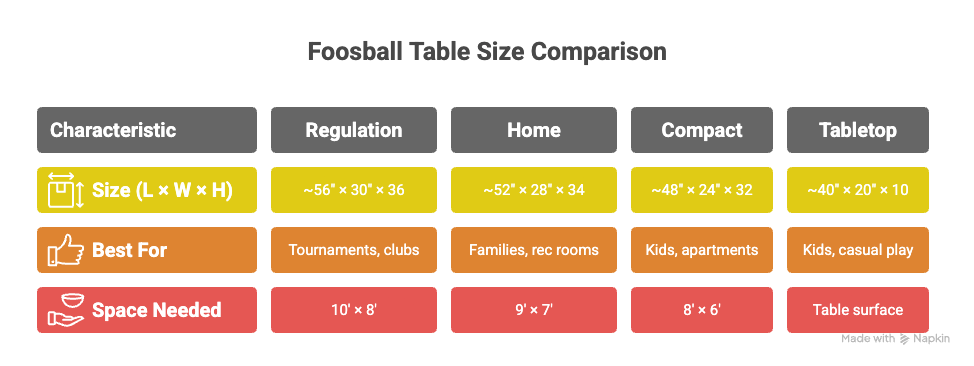
Regulation tables are the "big dogs." If you're training for tournaments or setting up a club, this is the size you'll want. But they need a dedicated space — almost the size of a small bedroom.
Home tables shave a few inches off the regulation size, making them a much better fit for living rooms or basements. They still feel authentic but won't eat up as much space.
Compact tables are the happy medium for small households. They're tall enough for adults and kids to enjoy but light enough to move around if needed.
Tabletop models? Think portable fun. Toss one on the kitchen table or coffee table and you've got instant entertainment without rearranging your house.
Here's a quick "cheat sheet" I like to use when helping people choose:
Go Regulation if you're serious about competition or want a pub-style experience at home.
Go Home if you're mainly playing with family or friends and want the feel of the real game without the bulk.
Go Compact if space is tight but you still want a standing table.
Go Tabletop if you've got kids or you just want something light, fun, and portable.
To put it into real-world terms, a regulation foosball table takes up about as much space as a dining table for six. A home table feels closer to a four-person dining table. Compact tables? Think of a small card table. And tabletops are no bigger than a big board game box.
That's why before buying, I always suggest actually marking the footprint on your floor with painter's tape. It's a simple trick, but it makes it crystal clear how much room you'll need.
Picking the right foosball table isn't just about grabbing the first one that looks cool. Trust me, size can make or break your playing experience! I've seen people buy a regulation table only to realize later they can't even extend the rods without smacking into a wall. On the flip side, I've seen families outgrow tiny compact tables in just a year. So, let's break it down.
Who's going to be playing the most? That's your starting point.
Kids: A compact or tabletop foosball table is usually the best bet. They're lightweight, easier to reach, and safer for little hands. Plus, if kids lose interest later, you won't feel like you blew your budget.
Families: A standard home-size table is the sweet spot. It's big enough for exciting matches, but not so massive that it overwhelms the game room or basement.
Serious players: If you're into tournaments or want to practice like the pros, a regulation foosball table is the only way to go. It delivers the authentic feel and dimensions you'll find in clubs and competitions.
Before you fall in love with a table, grab a tape measure. Seriously! Lay out the footprint of the table you're eyeing, then add about 3 feet of clearance on all sides for rods and player movement. This space buffer is non-negotiable if you don't want every match to feel like a battle with your walls.
Quick example: a regulation table is roughly 5 feet long. Add rods and clearance, and suddenly you're looking at nearly 9–10 feet of space needed. That's the size of a small bedroom!
Let's be real, price matters. Bigger usually means pricier, and you want your choice to make sense for both your wallet and your lifestyle.
Tabletop & compact tables: Most affordable, often under $500. Great if you want fun without a huge financial commitment.
Home tables: Mid-range, anywhere from $700 to $1,500. A balance of quality and space-efficiency.
Regulation tables: Premium investment. Prices can run from $1,500 up to $3,500+ for ITSF-approved models. Worth it if foosball is more than just casual fun for you.
Still torn? Here's a simple checklist to help you make the call:
Who will play most often — kids, adults, or both?
How much space do you actually have (after measuring)?
What's your budget comfort zone?
Do you want casual family fun or serious tournament-style gameplay?
If you answered mostly kids + small space + tight budget, go compact or tabletop.
If it's family + moderate space + mid-budget, home-size is your winner.
If it's serious play + lots of space + higher budget, regulation is the way to go.
For a deeper dive into brands, features, and price comparisons, check out our full Foosball Table Buying Guide. It'll walk you through everything step by step so you can shop with confidence.
At the end of the day, foosball is about fun. But the size of your table can make the difference between a game you enjoy every now and then… and one you play for years without getting bored.
Here's the bottom line: there isn't one "best" size. There's only the size that fits your lifestyle, space, and budget. Ask yourself:
The answers to those questions will point you straight to the right choice.
So, whether you're outfitting a game room, surprising your kids, or upgrading for tournament-style practice, the key is picking a table that fits your world, not just your wish list. Trust me, once you've got the right one in place, the laughs, the competition, and the late-night rematches will come naturally!
🎯 Want expert picks tailored to every size and budget? Check out our Foosball Table Buying Guide
🛒 Ready to bring one home? Browse our curated Foosball Tables Collection and find the table that's waiting for you.

Meryam Shakoor




placeholder